How Bees Find Their Way Back to a Hive
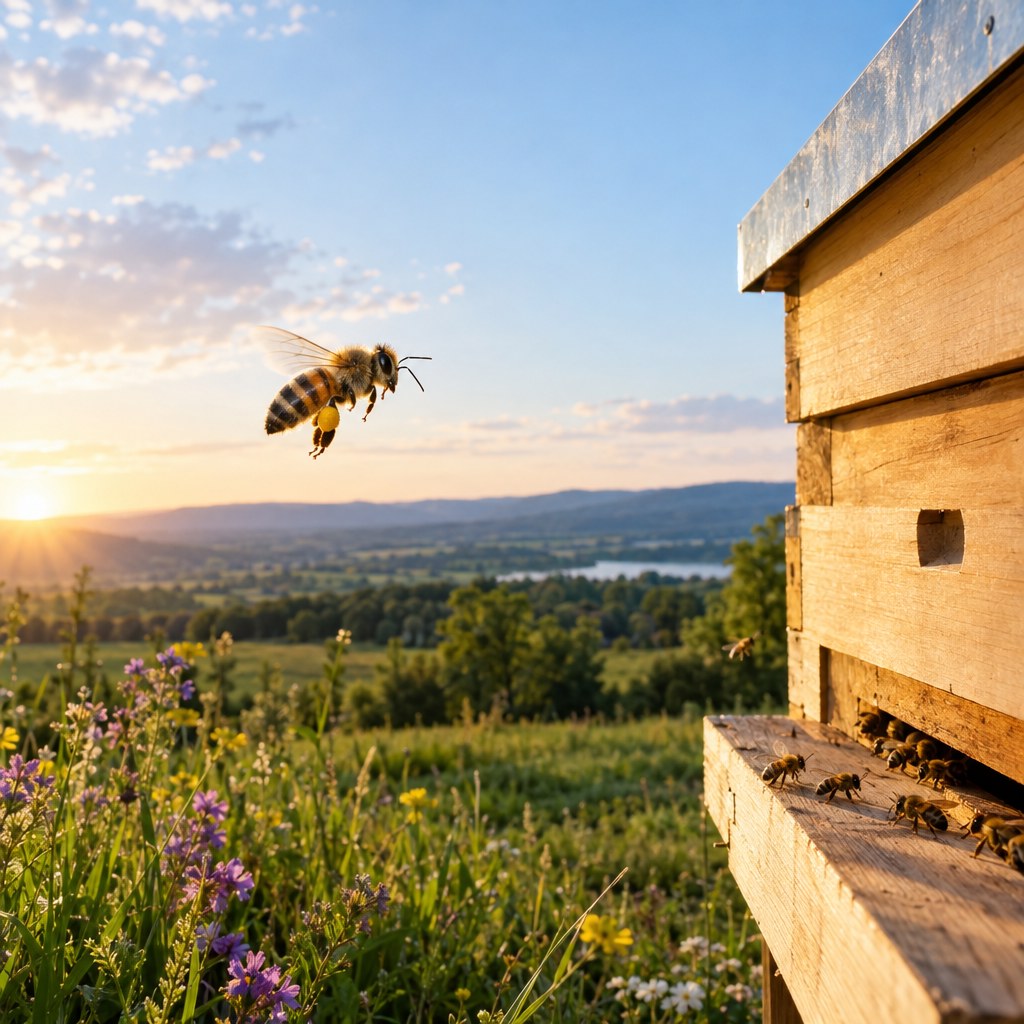
Bees return to a hive by combining the sun’s position, polarized light, landmarks, scent, and an internal sense of distance and time. If you keep bees or need to move a colony, understanding these cues helps you choose a safer location and reduce lost foragers.
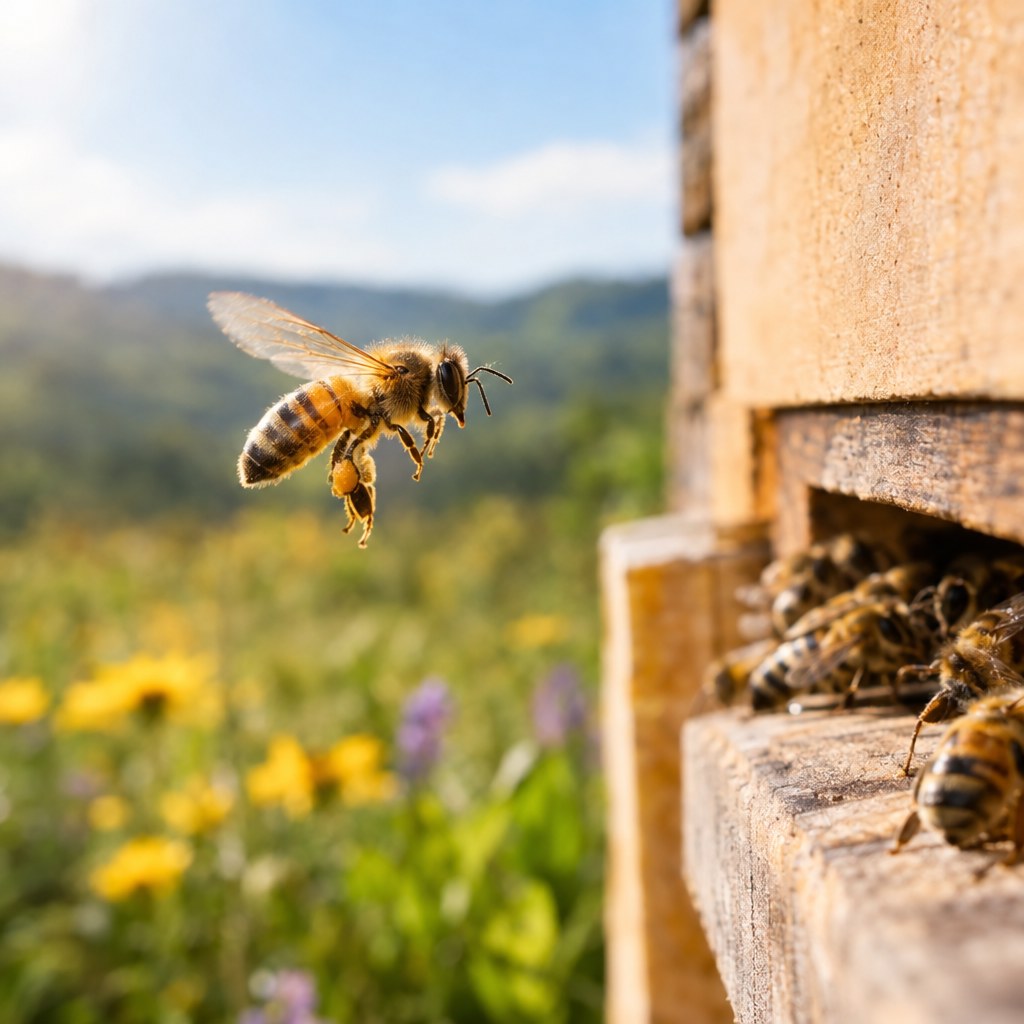
How the sun compass guides foraging bees
Honey bees use the sun as a compass and compensate for its movement with an internal time sense. When clouds hide direct sunlight, they can also detect polarized-light patterns that people cannot see.
This helps bees travel repeatedly between food and hive. It also supports the waggle dance, through which foragers communicate a resource’s direction and approximate distance relative to the sun.
What this means at the hive entrance
The sun compass works at landscape scale, but bees still need local cues. When hives look alike and face the same way in a straight row, returning bees may enter the wrong box. This is drifting, and it is more likely with crowded colonies, uniform entrances, or flight paths shaped by wind and terrain.
💡 Practical point: Distinctive entrance markers, varied spacing, and a clear flight path can give bees enough local information to separate colonies.
Landmarks, scent, and location memory
Bees learn the visual character of their home area during orientation flights. Young bees circle and loop in front of the entrance, gradually widening their range while learning the hive’s relationship to nearby objects and the wider landscape.
Useful landmarks include trees, walls, paths, rooflines, field edges, and vegetation changes. Bees also respond to contrast and patterns, so matching boxes provide fewer signals than hives with varied orientation, spacing, or simple entrance markings.
Scent confirms the final approach
Colony odor is another close-range cue. Each hive has a characteristic blend shaped by bees, brood, wax, pollen, honey, and stored materials, while guard bees inspect arrivals. Scent helps confirm the destination but does not prevent every bee from first approaching the wrong hive.
Distance is learned through effort, not a measuring tape
Bees estimate distance partly through optic flow: the apparent movement of visual detail during flight. A narrow, textured route can feel longer than the same distance over open ground. Wind, terrain, and the effort of carrying nectar also matter, so forage planning should consider accessible routes, not only straight-line distance.
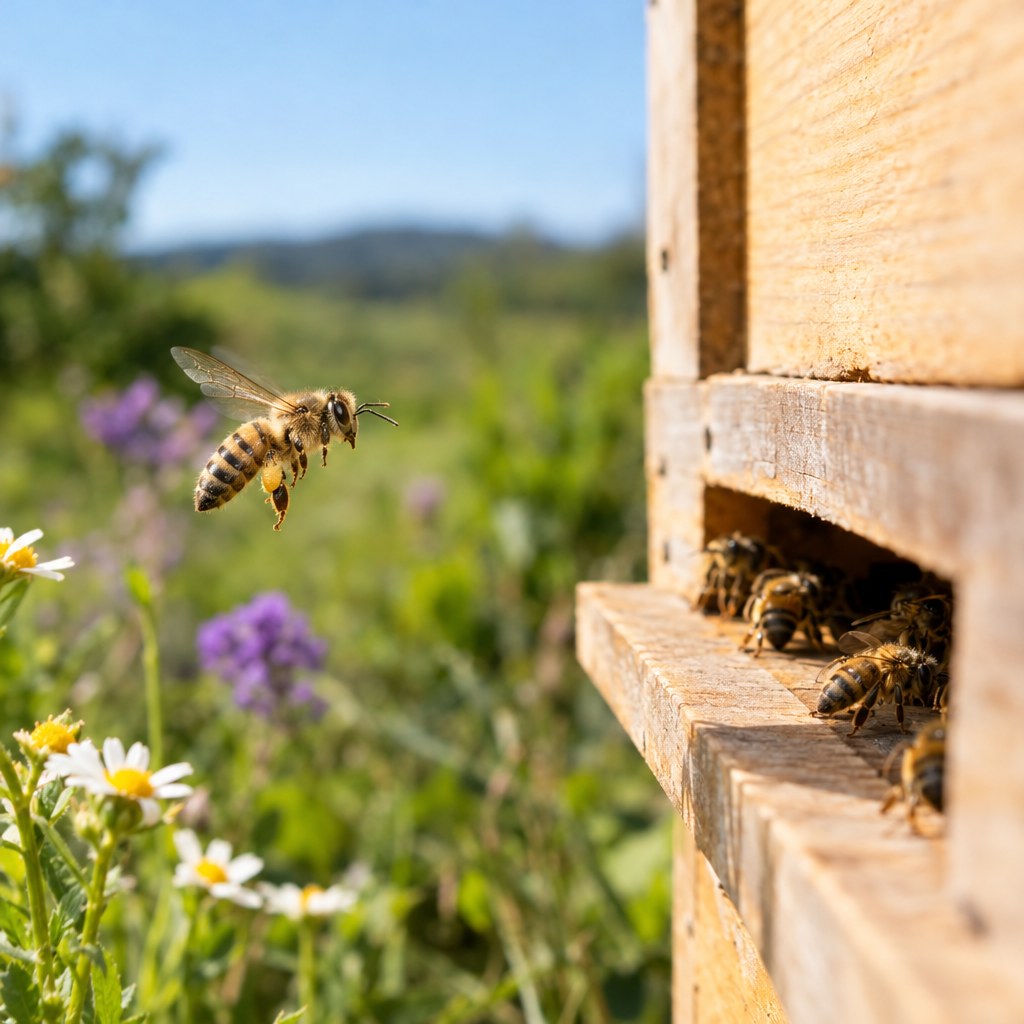
Why bees sometimes miss their hive
Even healthy, experienced bees can become disoriented. One missed return does not necessarily signal a colony problem, but repeated confusion after a site change warrants a review of the layout and conditions.
Practical hive placement checklist
Good placement supports navigation and helps manage inspections, neighbors, pedestrians, and maintenance. Adapt this checklist to your site, local rules, and local beekeeping advice.
- Choose a location with a clear approach to the entrance rather than placing hives behind dense, changeable clutter.
- Give each hive a recognizable position. Slightly stagger boxes instead of placing every entrance in one perfectly uniform line.
- Use stable visual distinctions, such as different entrance colors or simple shapes near the landing area. Avoid blocking the entrance.
- Orient entrances with the site’s wind, shade, foot traffic, and seasonal conditions in mind. There is no single best direction for every property.
- Keep hives level and secure so their position does not shift after orientation flights have begun.
- Plan a safe human route for inspections that does not cut directly through the busiest bee flight path.
- Check whether nearby reflective surfaces, major construction, hedge removal, or new structures could substantially change local landmarks.
With several hives, observe entrances during calm foraging periods. Unusual crowding at one box can reveal drifting or an entrance-management issue early.
How to move a hive with fewer navigation losses
Moving a colony most clearly shows how strongly bees remember a location. Foragers leaving from a new position may still return to the old one, especially when the move remains within their familiar flight area.
Use a deliberate move plan
- Decide whether the move is necessary now or whether you can wait for a lower-activity period.
- Assess the distance, terrain, access route, temperature, and need to secure frames, boxes, and entrances.
- For a small on-site relocation, move the hive gradually over repeated intervals so foragers can update their location memory.
- When a larger relocation is required, transport the colony securely and provide a temporary entrance obstruction, such as vegetation, that encourages fresh orientation flights when the hive is opened.
- After the move, watch the old site and the new entrance. A temporary cluster at the former location may contain returning foragers.
- Adjust the plan if bees repeatedly return to the original spot. A temporary collection box or consultation with a local beekeeper may help preserve more foragers.
No universal distance rule guarantees success because landscapes, weather, colony condition, and established ranges vary. Move in small, observable stages or make a full relocation that prompts reorientation.
Mistakes to avoid and how to recover
Moving a hive during active foraging without a plan
This is the most common mistake. Field bees may return to the old location. When practical, place a temporary box there to collect them, then reunite or relocate them carefully using methods appropriate for the colony.
Making every hive look and face the same way
Uniformity can increase drifting. Add modest visual differences and vary positions where possible. Do not rely on paint alone; spacing, orientation, and surrounding landmarks also matter.
Assuming any lost-bee pattern is normal
A few circling bees can be normal orientation. Persistent clustering, repeated returns to an old site, or congestion deserves attention. Check for hive movement, entrance reduction, landscaping, new obstacles, weather exposure, or a strong neighboring colony drawing drifters.
📋 Avoid unnecessary disturbance: Do not repeatedly open, move, or repaint a hive while assessing navigation behavior. Change one variable at a time, then observe traffic.
A simple decision framework
Match your response to the problem. If bees return normally, preserve stable conditions. For mild drifting, improve visual distinction and review the arrangement. If relocation is necessary, make reorientation central to the plan.
Instead of asking, “Can bees find home?” ask, “What navigation cues will remain stable before, during, and after this change?” That leads to better placement, landscaping, maintenance, and moving decisions.
Make the next hive change easier to navigate
Before moving or rearranging a hive, identify the cues bees use and make one controlled change at a time. Brief observation after each adjustment can prevent avoidable forager loss.