How Local Historians Research a Place

Local historians research a place by building a traceable account from maps, records, photographs, buildings, landscapes, and people’s memories. If you need reliable local background for a property, business decision, interpretation project, or community initiative, the goal is not to collect interesting stories; it is to test what can be supported, identify what remains uncertain, and document where each finding came from.
A sound local-history process helps you avoid repeating myths, overlooking significant constraints, or making decisions on incomplete context. You can use the same approach whether you are investigating one building, a street, a neighborhood, a former industrial site, or a rural settlement.

Start with a research question, not a source list
Good research begins by defining the decision you need to make. “What is the history of this place?” is too broad to guide efficient work. A better question identifies a location, time period, and purpose. For example: “What uses did this building have before its current conversion?” or “Which changes shaped this town-center block between the railway’s arrival and the present day?”
Your question determines which evidence matters. If you are planning repairs, you may need historic plans, ownership records, and dated photographs. If you are developing visitor interpretation, you may need a wider timeline, personal accounts, and evidence of how the place connected to the surrounding area. If you are assessing reputational or planning risks, focus on former uses, heritage designations, boundaries, and records held by the relevant local authority.
Set boundaries before searching
Write down the street address or mapped boundary, alternative place names, and the dates you want to investigate. Places change names, municipal boundaries shift, and street numbering can be revised. A parcel once described by a farm name may later appear under a village, district, or road name. Recording these variants early makes searches more complete.
- State what you want to establish, such as ownership, land use, construction, community use, or change over time.
- Set a practical date range, while leaving room to extend it if new evidence points earlier.
- List known names, spellings, nearby landmarks, and former administrative areas.
- Separate confirmed starting facts from assumptions that still need proof.
💡 Tip: Keep a research log from the first search. Note the source, date accessed, exact reference, what it says, and what it does not say. This saves time when you need to revisit a conclusion or explain your evidence to a colleague.
Build an evidence base from several source types
Local historians rarely rely on a single document. Each source was created for a particular purpose, so it reveals some things clearly and leaves others out. A map can show a building footprint but may not explain its use. A newspaper notice can name an event but may contain errors, abbreviations, or promotional language. The strongest account comes from comparing different kinds of evidence.
Read the physical place first
Begin with a site visit when access is appropriate. Photograph elevations, street signs, boundary walls, building materials, drainage features, inscriptions, memorials, and unusual changes in ground level. Compare what you see with historic mapping later. You are not trying to date every feature by appearance alone; you are creating observations that can be checked against records.
For example, a blocked doorway, mismatched brickwork, or an unusually wide access lane may suggest a change in use. It becomes useful evidence only after you test it with photographs, plans, trade directories, planning files, or other dated material.
Use records that answer different questions
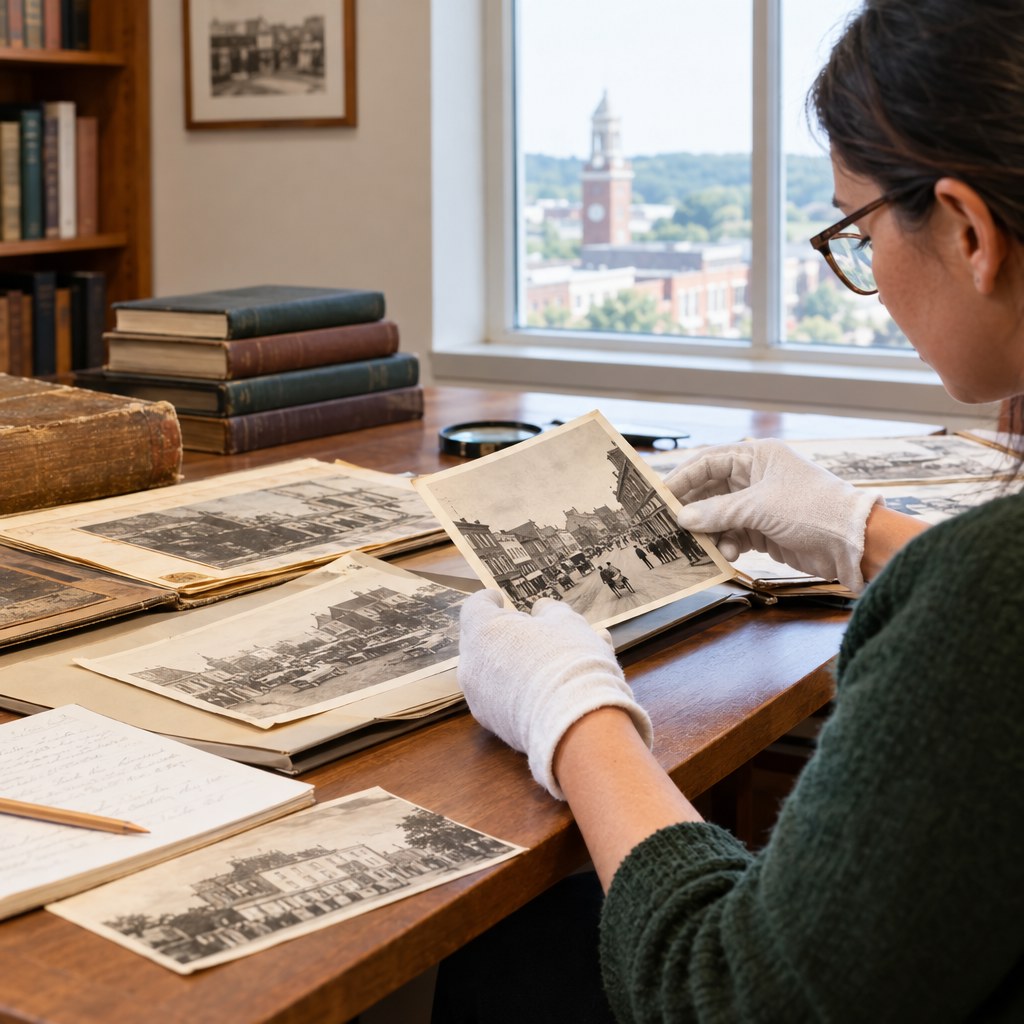
Search catalogues for archives, libraries, museums, local studies collections, historical societies, and public record offices. Their holdings may include rate books, electoral registers, title material, census returns where available, parish records, school records, maps, photographs, business directories, planning documents, and local newspapers. Digitized collections can accelerate discovery, but undigitized material often contains the most specific local detail.
Test and connect the evidence
The core skill is source criticism: asking who created a record, when, why, and how close they were to the event or place described. A document is not automatically accurate because it is old, official, or repeated online. Local historians assess provenance before treating a statement as fact.
Triangulate important claims
For a claim that affects a decision, seek at least 2 independent forms of support where possible. If a directory lists a workshop at an address, check a map, newspaper advertisement, rate record, photograph, or planning material. If an oral account recalls a building as a cinema, search for programs, licensing references, press reports, or dated images.
Independence matters. Ten websites repeating the same unsourced caption do not amount to 10 confirmations. Trace the statement back to its earliest identifiable source. If that source cannot be found, describe the claim as unverified rather than presenting it as established history.
Build a chronology and a map of change
Create a timeline with one row for each dated event, source reference, and confidence level. Then plot key changes on a current map or annotated site plan. This reveals gaps and contradictions. A building may appear on one map before the earliest surviving photograph; that does not prove construction in that interval, but it narrows the date range.
Use careful language in your final notes. Say “the evidence indicates,” “appears by,” or “is recorded as” when the record supports a limited conclusion. Reserve “was built in” or “was used as” for claims supported by clear evidence. This distinction makes your work more useful to decision makers.
Follow a practical workflow
You can keep a local-history project proportionate by moving from broad orientation to focused verification. Do not order large volumes of material before you know which questions matter most.
- Define the brief. Record the location, question, audience, date range, and decisions the research must inform.
- Survey the site and landscape. Make dated observations, take photographs, and mark features that require explanation.
- Create a search vocabulary. Include former names, likely owners, neighboring sites, trades, institutions, and administrative terms.
- Collect orientation sources. Start with maps, catalogues, directories, and reliable local reference works to build a preliminary timeline.
- Target primary evidence. Request or inspect records that can prove, challenge, or refine the preliminary account.
- Log citations immediately. Capture repository name, collection, item reference, page or image number, and access date.
- Rank findings. Label each as confirmed, probable, possible, or unresolved, with a short reason.
- Write for the decision. Present the timeline, evidence, uncertainties, and practical implications in plain language.
If you are commissioning research, ask for the scope, source list, methodology, evidence log, image permissions status, and a clear separation between documented findings and interpretation. This makes the final work easier to review and update.
Avoid common research mistakes and know how to recover
The most frequent mistake is treating an appealing story as a conclusion. Local legends can be valuable leads, especially when they preserve names or events absent from formal records, but they need checking. Another problem is relying on search-engine results without recording the original archive reference or publication details.
- Do not confuse a map date with a survey date. Check the edition, revision, and publication information.
- Do not force modern addresses onto older records. Compare boundaries, landmarks, and numbering systems.
- Do not crop out context from photographs. Signs, adjoining buildings, captions, and reverse-side notes may be the evidence that dates an image.
- Do not publish private details casually. Consider privacy, copyright, archive conditions, and the sensitivities of living communities before sharing material.
If you find a contradiction, do not hide it. Return to the source record, check whether two places have similar names, and test whether the records describe different phases of the same site. A contradiction often exposes a boundary change, a renumbered street, or a reused building name. Update your timeline rather than trying to preserve an earlier assumption.
Use a simple decision framework
Before you rely on a local-history finding, ask 3 questions: Is the claim relevant to the decision? Is the evidence traceable and appropriately strong? What remains uncertain? If all 3 answers are clear, you have a practical research result rather than a collection of disconnected facts.
For low-stakes interpretation, a well-labelled probable finding may be enough. For property work, public interpretation, heritage-sensitive changes, or claims that could affect stakeholders, seek stronger documentation and check applicable requirements with the relevant authority or qualified professional. The appropriate depth of research depends on the consequences of being wrong.
Turn local evidence into a usable record
Start with one precise question, keep a source log, and distinguish confirmed facts from informed interpretation. That discipline will give your place research lasting value.