Choosing Curtains for Light and Privacy
Choose curtains by treating light control and privacy as separate needs: a fabric can soften glare without preventing silhouettes at night, while a room-darkening lining can provide privacy but make a workspace feel closed in. The right combination gives you useful daylight when you want it, dependable screening when you need it, and a finish that suits how the room is used.
Assess the window and the room before choosing fabric
Start with the problem the curtain must solve, rather than with colour or pattern. A meeting room facing a busy street needs reliable privacy during evening use. A south- or west-facing office may need to reduce glare on screens while keeping the room bright. A bedroom or short-stay accommodation room often needs both daylight control and privacy at different times.
Observe each window at 3 points in the day: early morning, the brightest period, and after dark with interior lights on. Look from inside and, where practical, from outside. This reveals whether the issue is direct sun, reflected glare, overlooked windows, or a view that feels exposed only at night.
Questions to answer first
- Which direction does the window face, and when is direct sunlight strongest?
- Do people need to see out during working hours, or is maximum screening the priority?
- Will screens, displays, stock, or seating be affected by glare?
- Is privacy needed from passers-by, neighbouring buildings, or occupants in another part of the premises?
- Will curtains be opened and closed frequently, and who will operate them?
💡 Tip: Night-time privacy is the test many buyers miss. A sheer curtain that looks private in daylight can become transparent when the room is lit and the exterior is dark.
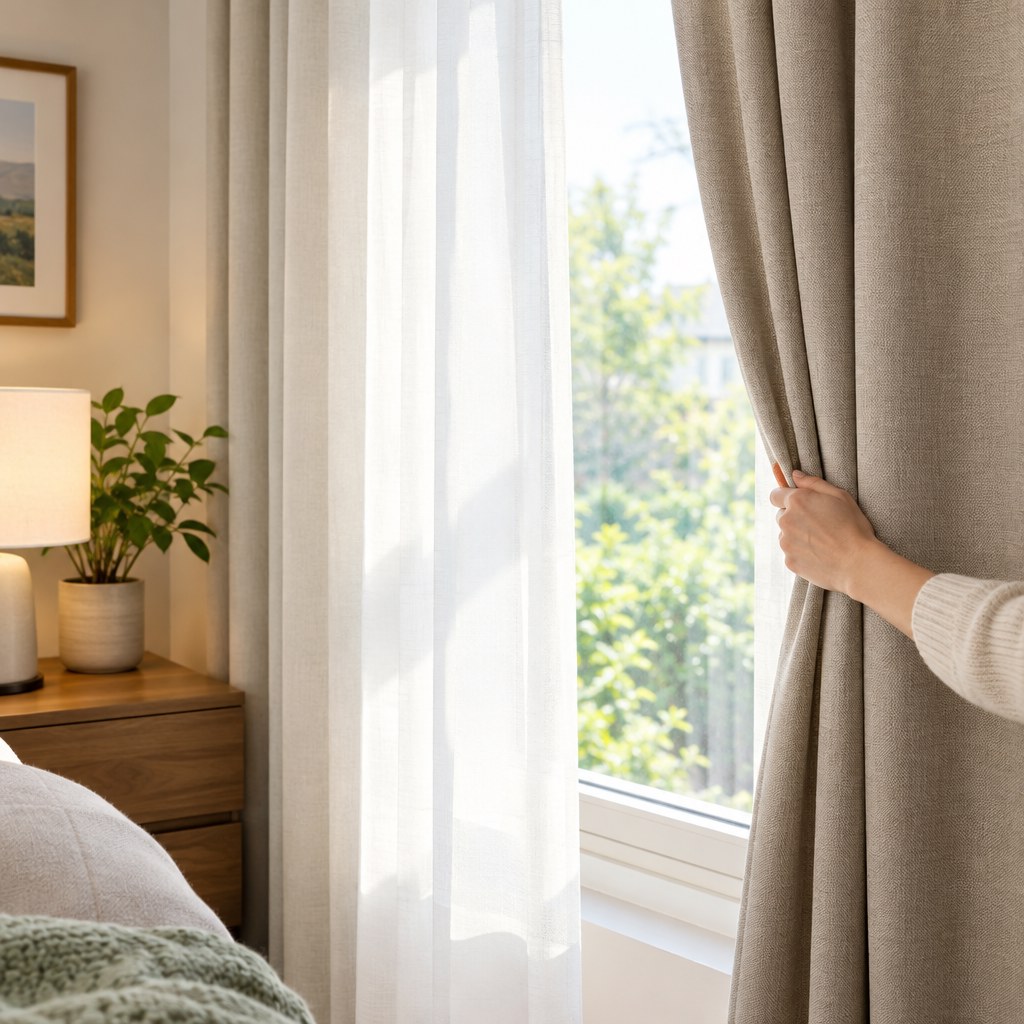
Match curtain fabric to the light level you want
Curtain fabrics are best understood by how much light they diffuse, filter, or block. The label “blackout” is not a complete answer: construction, lining, installation, and gaps around the edges all affect the result. Ask to see a fabric sample against the actual window whenever possible, because the same cloth can look very different in direct sun and artificial light.
Sheer or voile curtains
These soften harsh daylight and retain an open feel. Use them where daytime privacy is useful, but add another layer if people will use the room after dark.
Light-filtering fabrics
A closely woven, unlined fabric reduces brightness while preserving a softer view outward. It can suit offices, dining areas, and living spaces with moderate privacy needs.
Room-darkening and blackout curtains
These provide stronger light reduction and better night-time screening. They are useful for bedrooms, presentation spaces, shift-work rest areas, and windows with intense sun.
Understand lining and colour
A lining can make a decorative face fabric more effective without changing its appearance from inside the room. Dim-out or blackout linings are often a practical choice when you want a tailored look but need better light control. A thermal lining may also help reduce drafts near windows, though it should not be treated as a substitute for repairing poorly fitted windows.
Colour affects the atmosphere but is not a dependable measure of privacy. Pale fabric may reflect more daylight into a room, while darker fabric can reduce perceived brightness and make screen glare easier to manage. However, weave density and lining have a greater effect on screening than colour alone. If choosing a dark curtain for a compact room, balance it with a lighter sheer layer or a curtain that can stack fully clear of the glass.

Choose a privacy system that works day and night
For many rooms, a layered treatment is more useful than one heavy curtain. Pairing a sheer with a lined curtain lets you keep diffuse daylight and reduce daytime views in, then close the heavier layer for evening privacy. This approach is particularly effective in reception areas, street-facing rooms, and multipurpose spaces.
Common configurations
The heading system matters as much as the fabric. A ceiling-mounted track can make a window appear taller and allows curtains to cover a wider span. A pole offers a more decorative look but may leave more light at the edges, depending on brackets and finials. For wide glazing, check whether a single track can carry the fabric weight and whether the curtain stack will block part of the view when open.
Measure and specify the curtains carefully
Accurate measuring prevents the most common performance failures: narrow coverage, skimpy fullness, and exposed edges. Measure the track or pole position, not just the glass. Curtains normally need to extend beyond both sides of the window so that they can cover the opening properly and stack away from it when open.
A practical ordering checklist
- Decide whether the fitting will be wall-mounted, ceiling-mounted, recessed, or fixed inside a bay.
- Measure the full width of the track or pole, including the usable area at each end.
- Choose the drop: sill length, below-sill length, or near-floor length. Account for radiators, furniture, and cleaning access.
- Confirm the heading type, because eyelet, pencil pleat, wave, and pinch pleat curtains require different allowances.
- Specify lining, privacy requirement, and whether curtains must be washable or suitable for frequent use.
- Check the finished sample in daytime and night-time conditions before committing across multiple rooms.
Fullness deserves attention. A flat panel may technically cover the window but can leave gaps when drawn and look inadequate when closed. The amount of fabric needed varies with the heading style and fabric weight, so use the manufacturer’s guidance for the specific product rather than applying one universal multiplier.
Avoid common mistakes and recover quickly
Assuming every sheer provides privacy
Sheers obscure detail in daytime because outdoor light is stronger. At night, that relationship reverses. If you already have sheers and feel exposed after dark, add lined side panels, a separate blackout curtain, or another opaque treatment that can be closed when interior lights are on.
Choosing blackout fabric but ignoring gaps
Light can enter above the track and around the sides, especially when a curtain is mounted too close to the window frame. Increase the overlap beyond the glass, mount higher where suitable, and make sure the curtains meet at the centre. For demanding light control, discuss purpose-made tracks and return details with the installer.
Making maintenance an afterthought
Heavy lined curtains can be impractical where they collect dust, cooking residue, or frequent fingerprints. Review the care instructions before purchase and consider how the curtains will be removed, cleaned, and rehung. In high-use settings, simple headings and durable fabrics can be more practical than elaborate treatments.
⚠️ Check before ordering: If curtains are near heaters, doors, work equipment, or fire exits, confirm that the proposed drop and operation will not obstruct safe access or normal use.
Use a simple decision framework
Choose a sheer or light-filtering fabric when soft daylight is the main aim. Choose lined or room-darkening curtains when evening privacy and glare reduction matter. Choose 2 layers when your room needs both openness by day and dependable screening at night.
Your next step is to inspect the window at day and night, measure the planned track position, and compare fabric samples against the exact level of light and privacy you need.