How to Plan a Short Stay in Helsinki

Plan a short stay in Helsinki by choosing one compact base, grouping sights by neighbourhood, and leaving room for weather changes and unplanned stops. Whether you have 1, 2, or 3 days, a clear transport plan and a realistic daily pace will help you see the city without spending your visit in transit.
Helsinki works particularly well for short trips because its central districts are walkable, its public transport connects key areas efficiently, and many useful experiences—from design shops to waterfront walks and public saunas—fit naturally into a half-day. The best plan is not an exhaustive list; it is a flexible sequence of places that are close together.
Set your trip priorities before you book
A short Helsinki stay becomes difficult when you treat every attraction as equally important. Start by deciding what kind of visit you want: a culture-focused city break, a design and food weekend, a work trip with free evenings, or a relaxed introduction to Finnish life. Your answer determines where you stay, how much you reserve, and what you can comfortably skip.
Choose 3 anchor experiences for the whole trip. These are the activities you would genuinely regret missing, such as visiting a major museum, walking through the waterfront areas, trying a public sauna, or having a memorable Finnish meal. Then add nearby options rather than building a schedule around distant individual stops.
Culture and architecture
Prioritize central landmarks, museums, historic streets, and a waterfront route. Keep museum choices limited so you have time to enjoy the city between indoor visits.
Design and local life
Allow time for independent shops, cafés, market halls, and residential districts. This approach rewards a slower plan with fewer fixed appointments.
Work plus exploration
Build your plan around mornings or evenings rather than trying to fit in full sightseeing days. A central hotel can be worth more than a lower nightly rate farther out.
Be honest about arrival and departure times. A late arrival usually supports dinner and a neighbourhood walk, not a major attraction. On departure day, plan only activities you can leave easily if transport or luggage arrangements take longer than expected.

Choose a practical base, not just a cheap room
For a short stay, location affects your usable time more than almost any other booking choice. Staying in or close to the central districts makes it easier to return for a rest, change clothes for the weather, or adjust plans when a reservation shifts. It also reduces the pressure to decide every detail in advance.
Match the area to your working itinerary
- Central Helsinki: A practical choice if you want to walk to major sights, restaurants, transport connections, and shops. It is especially useful for a first visit or a short business trip.
- Design-focused inner districts: Consider these if boutiques, galleries, cafés, and a more neighbourhood-based feel matter more than being beside the main station.
- Waterfront or harbour areas: These suit travellers who value sea views and easy access to ferry routes, though you should still check the walk or tram connection to your planned activities.
- Outer neighbourhoods: These can offer a quieter stay, but only choose one if you are comfortable using public transport and do not need to return to your accommodation often.
💡 Tip: Before booking, map your accommodation against your 3 anchors, the main transport connection you expect to use, and one evening dining area. If each is straightforward to reach, the location is probably workable.
Check the property’s check-in process, luggage storage, breakfast arrangements, and cancellation terms before committing. These operational details matter when your visit is brief: a delayed check-in or inconvenient luggage plan can consume a meaningful part of a 1-day itinerary.
Build a short itinerary by neighbourhood
Instead of scheduling every hour, create one main area for each half-day. Helsinki’s compact centre makes this approach more efficient than repeatedly crossing the city for isolated attractions. Leave a buffer between your anchors for coffee, weather, queues, browsing, and changes of mind.
A workable 1-day Helsinki plan
Use the morning for a central walking route and 1 landmark or museum that matters most to you. Take lunch in the same general area, then spend the afternoon along the market, harbour, or a nearby design district. Finish with dinner and, if it is a priority, a sauna booking. This plan gives you variety without requiring tight timing.
A balanced 2-day Helsinki plan
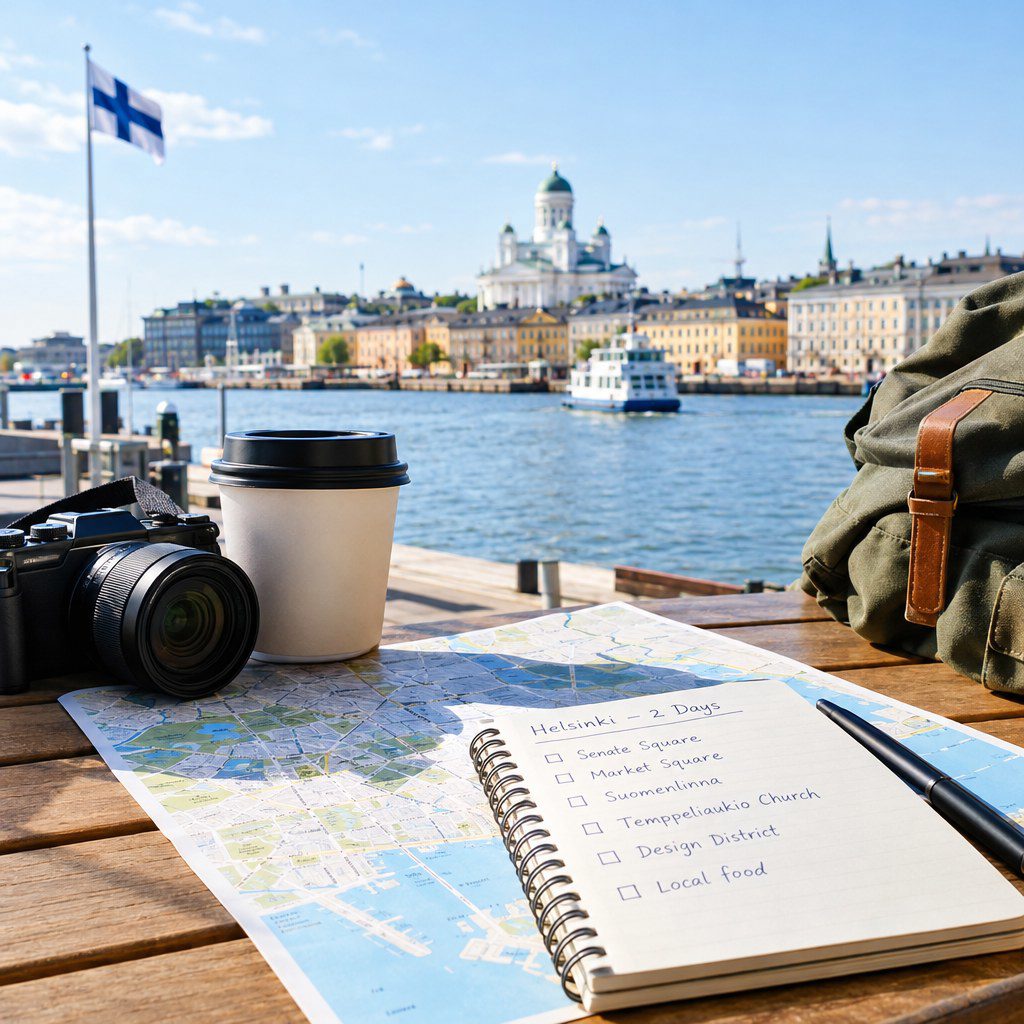
On day 1, focus on central Helsinki: architecture, public squares, a museum or gallery, and the waterfront. On day 2, choose a contrasting experience, such as a design-oriented district, a market hall and food-focused route, or an island and sea-facing excursion when conditions are suitable. Keeping the days distinct makes the trip feel fuller without adding unnecessary travel.
How to use a third day
A third day is best used for depth rather than distance. Revisit an area you enjoyed, take a slower breakfast, add a second museum, or make time for a public sauna and waterfront walk. If you want an excursion beyond the centre, confirm seasonal operations, travel time, and return options before making it your only plan for the day.
Prepare transport, weather, and bookings
Helsinki is easy to navigate when you decide in advance how you will make your first journey from the airport or arrival point to your accommodation. Check the current transport options, ticket rules, service hours, and route information shortly before departure, because operating arrangements can change. Save your accommodation address offline and keep enough time for transfers, especially after a flight.
Pack for changeable conditions rather than for an ideal forecast. Layers, comfortable walking shoes, and a water-resistant outer layer are sensible choices in many seasons. In colder periods, warm accessories are as important as a heavier coat because you may spend time outdoors between tram stops, markets, waterfront areas, and venues.
Reserve activities with limited capacity when they are central to your trip. Public saunas, popular restaurants, guided visits, and certain seasonal experiences may require advance planning. Do not overbook every meal or hour, however. A short city break benefits from having at least 1 open period each day.
Short-stay preparation checklist
- Confirm arrival and departure times, including the realistic door-to-door journey.
- Choose accommodation near your highest-priority areas or transport connection.
- Select 3 anchor experiences and identify a nearby backup for each day.
- Check opening days and current entry procedures for essential venues.
- Reserve only the activities that would materially disappoint you if unavailable.
- Review the weather close to departure and adjust clothing, not your entire itinerary.
- Download maps, booking confirmations, and travel details for offline access.
Avoid common planning mistakes and recover quickly
The most common mistake is trying to copy a longer itinerary into a weekend. It creates a trip defined by checking the time, not experiencing the city. Limit your non-negotiable activities, group the rest by location, and treat optional stops as choices rather than obligations.
Another mistake is assuming that opening hours, ferry schedules, weather conditions, or reservations will work as they did on a previous trip or in an old recommendation. Recheck official information close to travel, particularly for seasonal attractions and public holidays. If a key plan is unavailable, switch to the backup you chose in the same area instead of redesigning the entire day.
Finally, do not underestimate walking time in cold, wet, or windy weather. A route that looks short on a map may be less pleasant with luggage or poor conditions. Use cafés, museums, libraries, market halls, and other indoor stops as natural reset points. This protects your energy and keeps your schedule flexible.
Use a simple decision framework
For a successful short stay in Helsinki, make decisions in this order: first choose your trip priorities, then book a location that supports them, then plan each half-day around a single area, and finally reserve only the experiences that need a time slot. If a choice does not improve convenience, comfort, or a genuine priority, it probably does not belong in a short itinerary.
Your next step is to write down your arrival window, departure window, and 3 anchors. Put them on a simple map, choose accommodation that reduces the longest journey, and create 1 weather-proof alternative for each day. That small amount of planning gives you structure while leaving Helsinki room to surprise you.
Plan for connection, not completion
Choose a compact route, protect time for your priorities, and keep enough space to enjoy the city at your own pace.